MoonPyramid
A lot of the great engineering and creativity in this little mission is down to Ian Parker and Solutek. Ian kindly procured a flight as a joint mission, because Astrobotic said there would be no re-flight of payloads from Peregrine-1. However, Astrobotic then told me that I would be re-flying, so we ended up with a Gemini mission! 🙂
Following on from the dramatic and fascinating flight of Moon199, we are re-flying on Astrobotic’s Griffin Mission One lander! This mission is planned to land near the Nobile Crater at the Moon’s south pole in late 2025. I love the stories of the pioneering South Pole explorations of the Earth so I’m excited about being part of (robotic) South Pole exploration on the Moon!
When I heard about this opportunity, the name Nobile was already familiar to me. The crater is named after Umberto Nobile, an Italian aviator, aeronautical engineer and explorer. The name choice is interesting, because Nobile was associated with the North Pole, not the South Pole. What’s particularly interesting is that Nobile designed and piloted airships to carry out polar exploration, notably the Norge, built for Roald Amundsen. Together, they carried out the first verified trip of any kind to the North Pole, an overflight on 12th May 1926.
 Nobile and Amundsen’s Norge in the Arctic

Anyway… back to the moon… Here’s the first part – the parcel from Astrobotic, which arrived 110225, with the container that needs to be returned to them by early March 2025.
Samples needed
As with Moon 199, a couple of hairs from anywhere, ideally with the root, because this holds the nuclear DNA, which contains the most information. Tape them to a piece of paper, ideally at the non-root end, mark the name of the passenger and return to me by 26th February 2025.
If you are clever, you can work out my address (I am Shaun Whitehead 😉 ), which is where I’d like you to send passengers 🙂

What’s this mission going to be about? We’re sending your DNA, but more than that – just to turn the ancient aliens/pyramid thing on its head, we’re sending the Great Pyramid into space! So it will be the same super-tough tungsten container, with the Great Pyramid inside, along with some of you and perhaps a secret….

The package – cool fabric mission patch!
160225: I’ve been thinking about it a bit more – contemplating symbology, chemistry, structural mechanics… We know that the capsule is going to be made from incredibly tough tungsten, and that we’ll use the maximum available volume for the payload. So it will look like our last moon capsule:

Moon199 capsule from previous mission
The priority is to make it super-tough, so rather than having a pyramid-shaped hollow, we’ll have a spherical hollow to remove stress concentrations. Eggs are egg-shaped for a good reason! Also, we want to keep as much of the outer tungsten shell as possible, so the cavity will be quite small, about 4mm diameter.
Right now I don’t know how I will join the halves of the capsule together. Last time we laser-welded a lid on, but this time perhaps the two capsule halves will be mated using a precision screw thread and designed to encourage cold-welding – which is what happens when two super-smooth, very clean metal surfaces come together. Normally as engineers we try to avoid this, but in this case it could be beneficial. It’s great that the talented Ian Parker at Solutek, who did so much on the machining of the previous mission, is collaborating again. It means that few ideas are too strange or difficult.
There has always been a fascination with fitting circles and spheres to the geometry of the pyramid, so to turn this thinking on its head we will literally turn the pyramid into a sphere that fits snugly into the cavity of the capsule. Again, using a sphere keeps it all nice and strong. The sphere is a “composite” of your DNA, the Great Pyramid itself, and a binder.
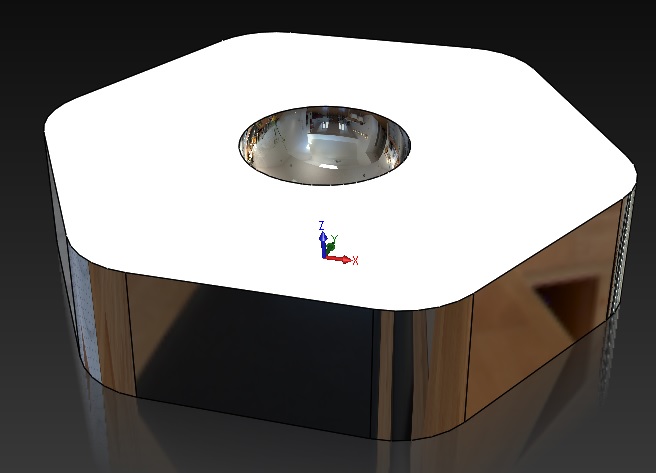
Half-capsule
My plan is to chop each hair sample into quite a few ~2mm pieces. I’m going to check, but it appears that DNA encapsulated in epoxy does not damage it.
The pyramid part is the limestone that comes from parts of the Great Pyramid that no human will ever access. Occasionally our robots come back down the “air shafts” leading from the Kings and Queens Chambers, with little pieces of pyramid embedded on them. It is of course impossible to replace this material, so I have collected samples over the years.
By mixing the fragments of hair strands into the epoxy, we form a robust composite material so that we are all contributing to the strength of the capsule, and we are all being more sociable than we were in the last Moon199 arrangement 🙂
Assuming we use 10mm lengths of hair and each is 100 microns diameter then I estimate that a sphere containing one third each of DNA samples, pyramid and binder could carry several hundred passengers, but I am limiting this mission to a small number.
180225: After lots of discussion with Ian Parker about the practicality and robustness of designs… I wanted to incorporate some sort of feature that would be reminiscent of Ancient Egyptian techniques. The lid of the sarcophagus in the Kings Chamber of the Great Pyramid is missing, but there are clues about how it was cleverly secured in place. It was clearly slid into a groove, and stone “pins” had dropped down into holes – so that once it was in place, it could not be slid back off again. Like a puzzle box. The “puzzle box” that Ian and I came up with is simpler:

The capsule
The plug and recess in the capsule are slightly tapered, for two reasons: to allow air out (otherwise it would be really difficult to push in the plug) and to wedge the plug into place for eternity. It was only after we came up with this design that I realised I had seen it before. The builders of the pyramid had carefully crafted exactly the same arrangement, perfectly building a hole that at least three granite blocks could be slid into, blocking the entrance to the wonderful Grand Gallery above:
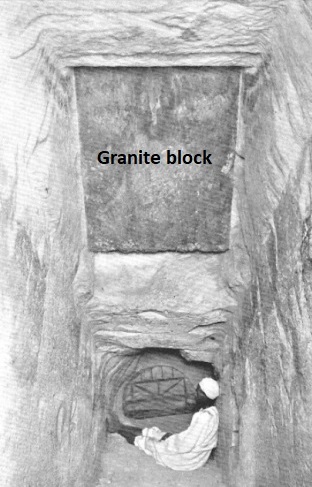
Granite block wedged in place, protecting the entrance to the Grand Gallery
040325: The last week or so has been a bit of a blur so I’m just capturing all of this while I can:
Ian and I are sharing two capsules and Ian and his company Solutek have been carrying out some fantastic machining to produce the capsules. The first capsule was as described above. The second capsule has a volume for “memory” things.
Wire Electrode Discharge Machining of the plug tor a precise fit – magical!

Sparking and electrode dressing created this beautiful cavity-
but it has a tiny cavity within the cavity!
Within the cavity is a 1mm lab grown diamond that was part of the series used in Ian and Mandy’s wedding rings. Ian thought of this in honour of absent friends and symbolising the pyramidion of the pyramid, pointing to the cosmos – after all, some have suggested that the pyramid was a machine for shooting the pharaoh to the stars!
We also included gold filings for a bit of sparkle, which will mingle with passengers.
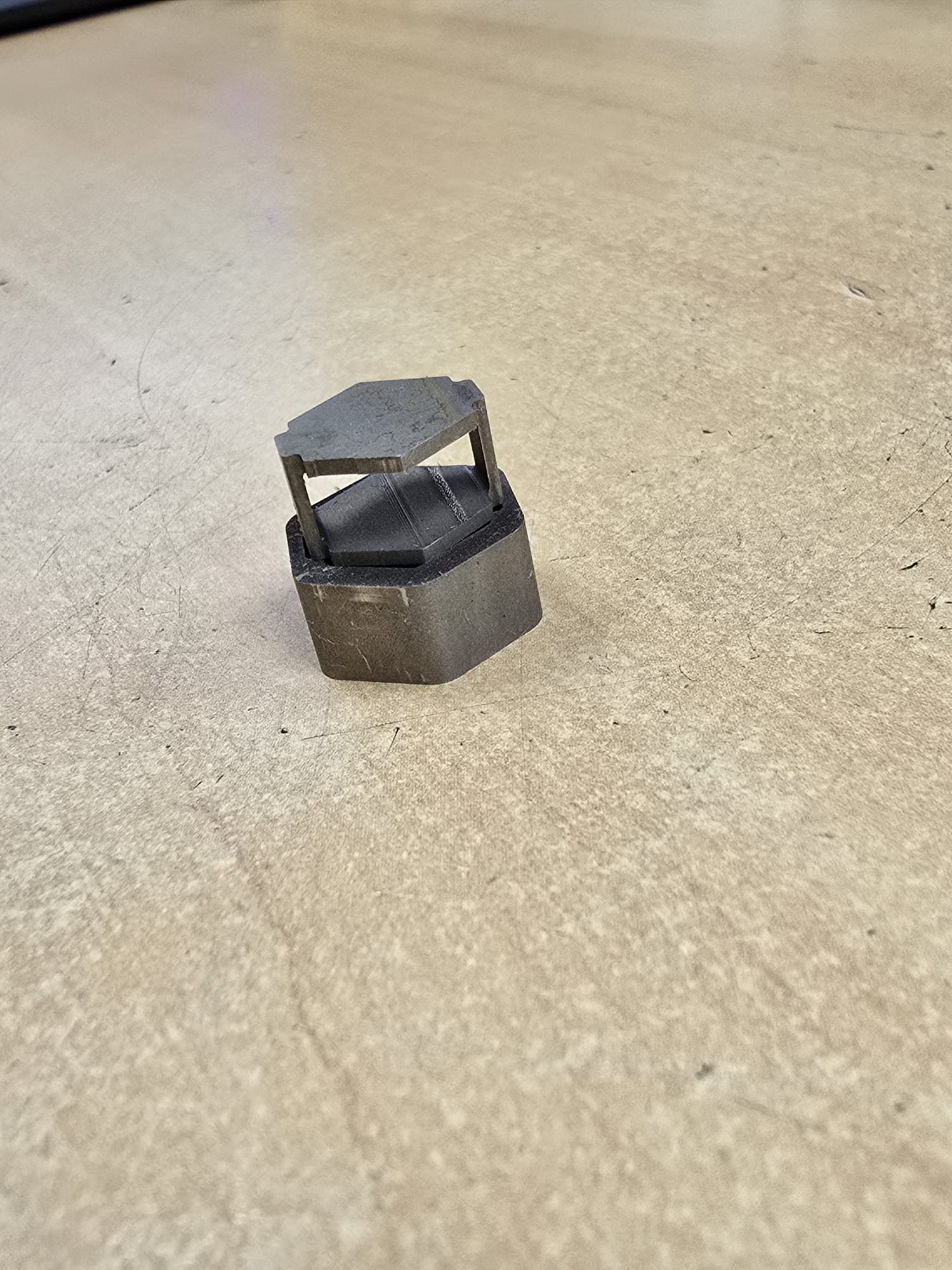
Memory capsule before polishing and laser engraving
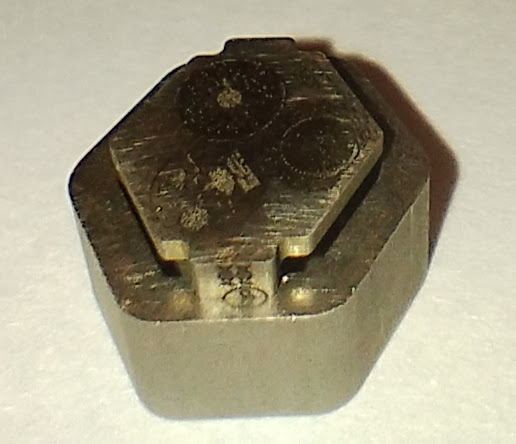
Memory capsule after polishing and engraving, with a secret or two inscribed upon it
Anilore Banon’s Vitae artwork on top
Wrangling the DNA sample “passengers” was the usual tricky, painstaking, challenging, slightly frustrating job so I won’t go into details – except to say that it takes a lot more effort than one might imagine, especially as some hairs came complete with electrostatic charge that made them rather unruly! I had the bright idea of dispensing them onto an antistatic mat, it was only after I had done this with several hundred hair fragments that I realised that they were then firmly stuck to the mat! Alison and I (well, mainly Alison at this point!) carefully rounded up every single piece and it was at this point that I decided to forego the epoxy and see if they could be compacted into the sphere.
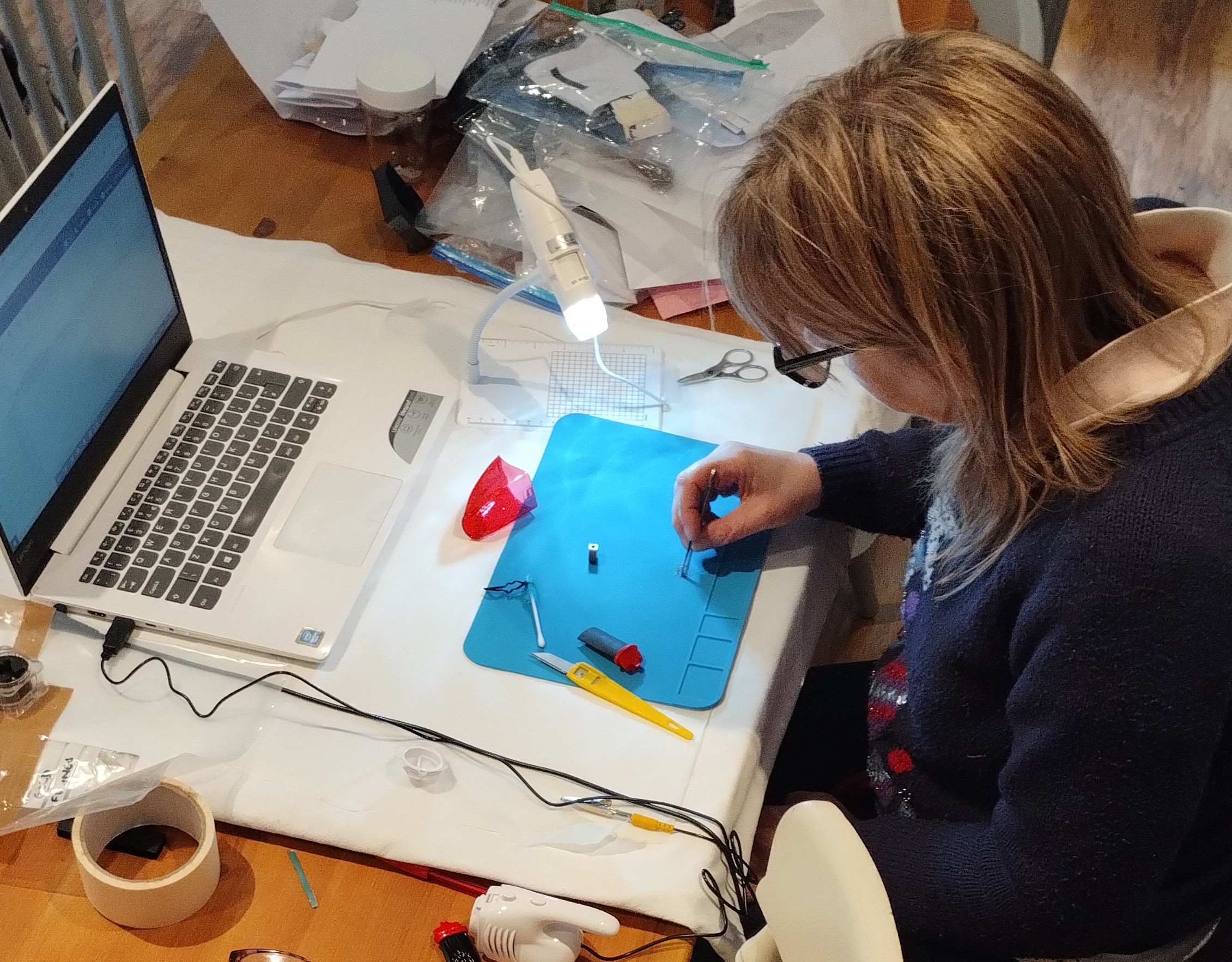
Alison wrangling DNA passengers
This technique worked very well, so the majority of passenger were loaded with pyramid, gold dust and diamond!

A mound of the finest pyramid dust from deep within the heights of the last remaining wonder of the world
I had been leaving the plug resting in the capsule to keep the passengers safe, then one morning I discovered that – bizarrely, the plug had somehow closed itself, making it practically impossible to remove without damaging it! So I took it as a sign, and squeezed the plug and capsule together in a vice, sealing the first one for eternity, aliens, or one of you future astronauts 🙂

First capsule sealed up
Then I turned my attention to the “memory” capsule. This was to contain nearly 7000 handprints that Anilore had collected for the Vitae project over the years, 3.5GB of data in total. Ian and I decided that we would also add photos of our own, so we needed two chips. I wanted to experiment with off-the-shelf chips, but after mangling a few SD cards, thumb drive etc to find out exactly what was within, I found that none were small enough or accessible enough to work out how to use in a short time.

This is what’s inside one of those tiny USB memory stick thingies – too big!
Fortunately, I discovered a strange SD flash board that had a tiny 4GB memory chip on it, so bought a handful of those:
The chip on the little SD flash board
They behave like microSD cards but they’re not. Turns out that they weren’t as easy to pour data into as I had imagined, but it was (sort of) fun working through the code, and using an Arduino as an interface:

Tiny Arduino, tiny memory chip board, with an even tinier memory chip on it
After much weirdness and frustration, it started working, but painfully slowly… more than one day to load Anilore’s 3.5GB…
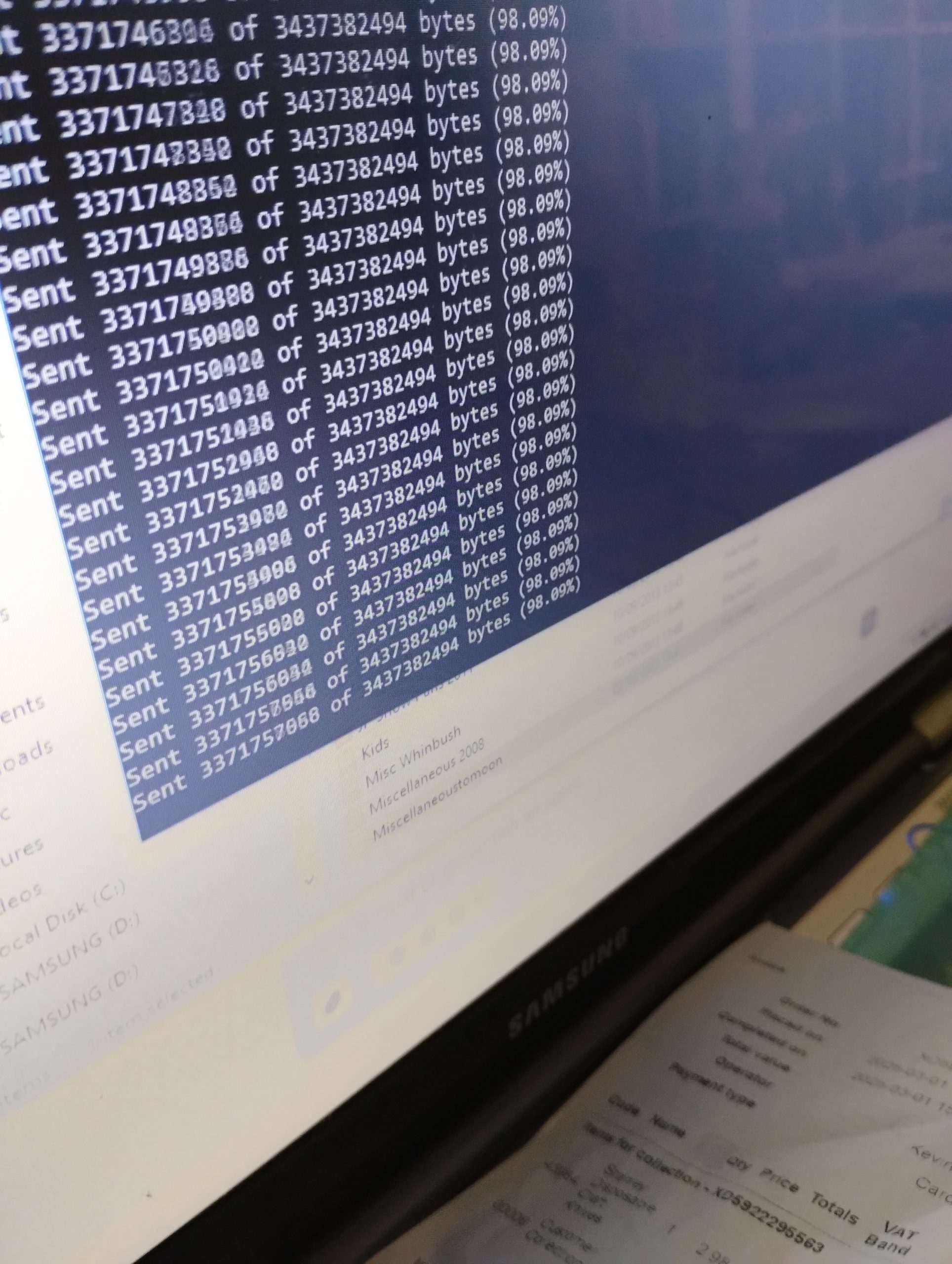
Slowly…. writing memories…

Done! All of Anilore’s files (VI1.ZIP) plus a fun lunar test message. Another secret…

And the other memory files…
The files were copied multiple times so that even if ionising radiation corrupts some of the memory, it is unlikely that the damage will be replicated on both memories – ie we have redundancy, which space engineers like 🙂
Next I had to remove the memory chips from the boards without damaging them, so I turned to the excellent guy who maintains our computers – William at Aardvark in Darlington. The chips were removed beautifully, cleaned and ready for use:


Cleaned memory chips
I stacked the chips on top of each other for robustness:
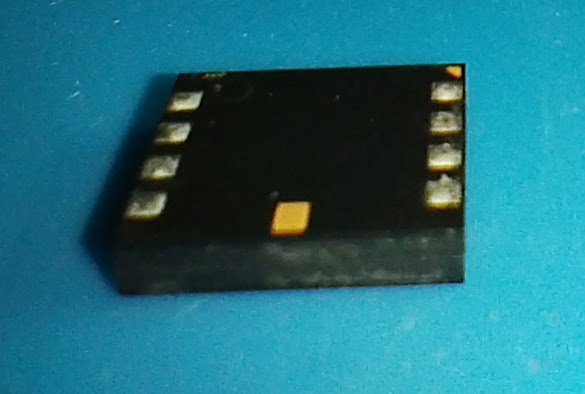
Twin memory chips
They remind me very much of the monolith in the epic sci-fi film 2001: A Space Odyssey:

The astronauts approach the monolith in 2001: A Space Odyssey
And then the tricky part. Some of the remaining passengers (plus copies of passengers from the other capsule, to keep them company) were also mingled with pyramid and gold dust, then placed in a “mould” on top of the chips. I then poured some epoxy in, to firmly fix and protect them. At this point there was slight panic. The epoxy just formed a blob on top of the passengers, and it was setting quickly. I had a sudden vision of having to completely unravel all of the passenger as they were jumping around, avoiding the epoxy. However, after I had gently warmed the whole assembly, it settled down a bit and I realised that all was well, just a few passengers sticking above the solid epoxy “bath”. So a fresh layer of epoxy on top of those, and all was well. Phew!
I did a fit check within the capsule:
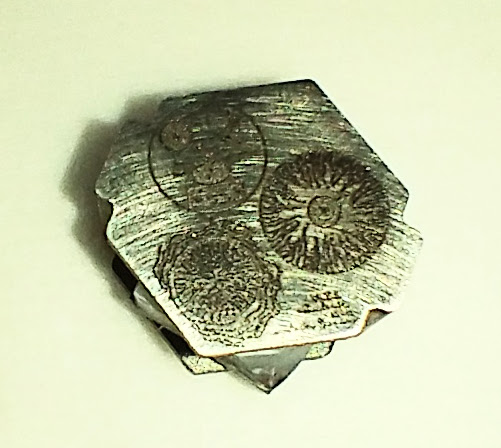
Memory chips and passengers in capsule (not in correct orientation here!)
Then I shaved a tiny bit off the corners of the whole assembly to get it to fit. I had previously contacted the manufacturer to get a layout of the chip to confirm that removing a small amount of the material would not damage the memory…

Memory chips sitting on top of passengers, with shaved corners
…and it fit like a glove, so I squashed it all together right away:
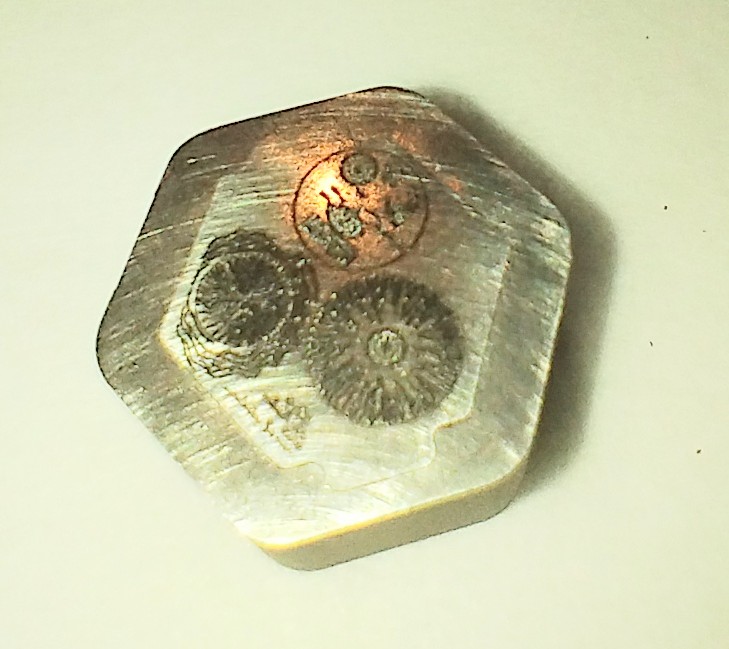
Second capsule completed
I had left a small gap above the passengers in the inner capsule, but everything fit so snugly, and the whole inner assembly is so lightweight, that I felt there would be no issues with movement during launch. As a cross-check, I took a spare memory chip and tapped it for two minutes, as a rudimentary vibration test, and it was perfectly fine – of course.

Both capsules together
Then a rush to pack it all up…


…and get it booked in with FedEx for delivery in two days time (today being 040325)…

…and off to the trusty local drop-off shop! Which wasn’t so trusty, as they appeared to be decorating the place, and said they were closed, despite us having booked in with them. Anyway, that meant an exciting trip to the massive FedEx depot at Teesside Airport:

Done! Now it’s over to FedEx and then Astrobotic
070325: The capsules have arrived at Astrobotic! But that’s not the interesting thing. The interesting thing is that their last stop before that was the romantic-sounding Moon Township:
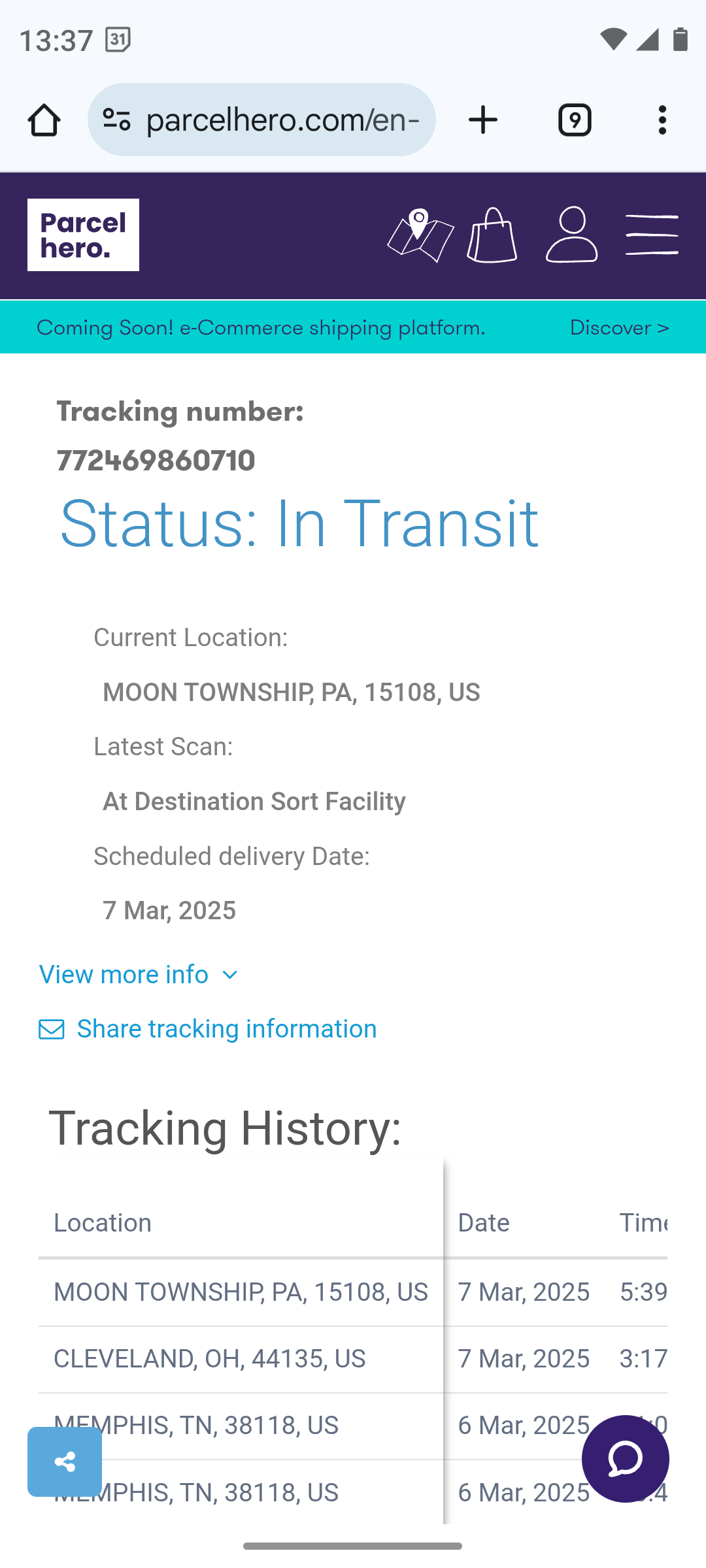
I wondered if this place name was based on Astrobotic, but it existed long before Astrobotic came into being. The story goes that it originated from early settlers describing the crescent-shaped bend of the Ohio River in the area as resembling a moon. Strange, eh?
All information and updates will be posted here…..
241125: I waited until I had some useful information to post here… There is plenty of progress on the lander, but ” The team is targeting the next viable launch window, which opens in July 2026″. Not much more to add, except this image of the lander sitting behind one of its fuel tanks. It’s looking very festive!
